

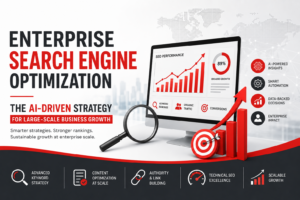
Enterprise Search Engine Optimization: The AI-Driven Strategy for Large-Scale Business Growth
Let’s assume your company has hundreds of pages on its website, it operates in multiple locations, and serves thousands of customers. But imagine that many of those pages are barely getting any traffic, some are competing against each other on Google, and because of this, potential customers are landing on the wrong pages. Managing SEO for a large website is very different from optimizing a small business website with 20 or 30 pages. There are more products, location pages, teams, competitors, technical issues, and smooth customer navigation to consider. This is where Enterprise Search Engine Optimization becomes important. With AI entering this field, the functioning of Enterprise SEO has evolved. AI helps analyze huge websites and search data, identify patterns, find content opportunities, and support faster decision-making. But AI is only one part of the strategy. Human experience is still needed to understand the business, customers, competition, and goals behind the data. Let’s look at it in detail. Why Large Businesses Need a Different SEO Strategy A large website, which works beyond boundaries, generally contains hundreds or even thousands of pages. As the website grows, connecting every page and managing the technicalities of the website becomes harder. For example, imagine an online retailer selling products across Australia. It may have separate pages for categories, products, brands, locations, and services. If these pages aren’t organized properly, Google may struggle to understand which pages deserve visibility, and they might get hide and customers might not get access to them. A strong enterprise strategy helps businesses manage: Large website structures Thousands of keywords Multiple locations Product and service pages Technical SEO issues Content optimization Internal linking Competitor activity and content gap Search intent This is why SEO for Enterprise Companies needs more than basic keyword placement. How AI Is Changing the Working of Enterprise SEO AI can process large amounts of information much faster than a person working manually. This makes it useful for businesses managing large websites. 1. Find Opportunities Faster AI-powered tools can analyze keyword data, search trends, competitors, content gaps, and website performance to identify potential opportunities. For example, a hotel chain may discover that customers are searching for specific terms related to family stays, business accommodation, or airport hotels. Instead of creating random content, the company can use this information to build pages around genuine customer searches. 2. Identify Content Gaps Large websites often have content that overlaps or misses important topics. AI can help identify: Important topics competitors cover that you lack Questions customers ask Missing subtopics Pages with declining traffic Content that needs to be updated or refreshed Enterprise Website SEO specialists can then review these findings and decide what should actually be created, improved, combined, or removed. This makes the work simpler and faster, and therefore, the result can be measured within weeks or in a few months. 3. Improve Internal Linking Internal links help users and search engines move through a website smoothly. On a large website, manually checking thousands of pages for linking opportunities can take a significant amount of time. AI-assisted analysis can help identify related pages that should be connected together. For example, a blog related to the benefits of solar panels can be connected to the service page, and this way, your blog ultimately can fetch customers. What Makes Enterprise-Level SEO Different? Enterprise-Level SEO involves coordinating many parts of a website rather than focusing on individual pages. Technical SEO at Scale Technical problems that seem small on one page can become major issues when repeated across hundreds of pages. This can range from navigational problems to late responding of the website, which can restrict potential customers from visiting and availing a service. Common technical issues are: Slow website loading speed Mobile usability issue Crawlability Duplicate content Broken links Redirects failure Improper indexing Site structure Structured data For example, if a website accidentally creates thousands of duplicate product URLs, search engines may waste time crawling unnecessary pages. Therefore, regular technical monitoring helps businesses find and fix these problems before they affect larger parts of the website. Content That Matches Search Intent Large businesses often create lots of content, but quantity doesn’t automatically mean better results. The real question is: Does the page answer what the customer is actually looking for? Someone searching “best running shoes for beginners” is probably just searching for it. While someone searching “buy running shoes online” is more likely to make a purchase. An effective enterprise strategy considers these differences and creates content for different stages of the customer journey, specifically targeting the one who is ready to turn. Enterprise Website SEO Needs Strong Organization When many teams work on one website, SEO can become difficult to manage. Marketing teams create content, developers change the website, product teams may add new pages, and regional teams may publish local content. Without proper coordination, these changes can create SEO problems. Therefore, a strong Enterprise Website SEO strategy establishes clear processes for: Creating new pages Optimizing existing content Managing redirects Maintaining internal links Monitoring technical changes Updating outdated content Measuring organic performance This ensures SEO becomes part of the website development process rather than something added after a problem appears. How Businesses Can Use AI Without Losing the Human Side AI can make SEO faster, but businesses shouldn’t depend on automation for every decision. For example, AI may identify a keyword with high search volume. However, that doesn’t automatically mean the keyword is valuable for your business. For this, you need an expert SEO professional. An SEO expert asks and works: Does this keyword match our services? Are these users likely to become customers? What are competitors offering? Does our website have the right page for this search? What would make our content more useful? Therefore, a combination of AI analysis and human judgement can create a much stronger strategy. Why Choose SpotCodes for Enterprise SEO? At SpotCodes, we understand that large businesses need more than generic SEO recommendations. Our approach combines data, technical optimization, content strategy, search intent, competitor