

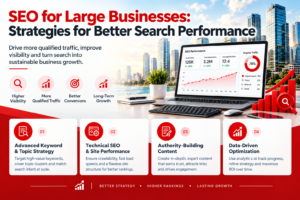
SEO for Large Businesses: Strategies for Better Search Performance
Running a large business does not automatically mean your website will appear at the top of Google. In fact, larger websites need more thoughtful strategy as they come across more SEO problems because they have hundreds or even thousands of pages, multiple services, different locations, and a wide range of customers. This is where managing SEO for Large Businesses becomes important. So, instead of treating every page in the same way, a large website needs a structured SEO strategy that improves technical performance, content, keywords, and overall search visibility. SpotCodes Technologies provides tailored SEO services designed to help businesses improve organic visibility, attract relevant traffic, and generate more leads through search. Its SEO services include enterprise SEO, local SEO, SEO audits, page speed and Core Web Vitals optimisation, and other organic search solutions. Let’s look more at how Spotcodes can help uplift your business. Why Do Large Businesses Need a Different SEO Strategy? A small business may have a few important service pages and a limited number of locations. A large business can have hundreds of products, services, locations, or website pages. This creates more opportunities for SEO problems. For example, imagine a company operating in 20 cities. Each location may need relevant content and local optimisation. If the pages are poorly structured, contain duplicate information, or target the same keywords, search engines may struggle to understand which page should appear for a particular search. An effective strategy can focus on: Website structure and technicalities Keyword research and search intent On-page content optimisation Local SEO for relevant locations Website speed and Core Web Vitals SEO audits and regular improvements Link-building strategies Performance tracking The goal is not simply to increase the number of pages ranking. It is to make the right pages visible for the searches that matter to the business. 1. Begin with Website Audit/ Analysis Before making major SEO changes, it is important to understand what is already happening on the website. An SEO audit can identify technical and content-related problems that may affect search performance. SpotCodes provides SEO audit services to help identify areas that need improvement. For a large website, an audit can look at areas such as: Broken links Indexing issues Duplicate pages or content Website speed Mobile usability Page structure Metadata Internal linking Keyword targeting Existing content performance For example, a company may have an old service page that receives traffic but no longer matches the service it offers. Instead of creating another similar page, the SEO team can review the existing page and update, improve, or redirect it. This helps prevent a large website from becoming difficult for both users and search engines to navigate. 2. Build a Clear Keyword Strategy Keywords are not included in websites and webpages to get higher ranking, its main aim is to attract the right user who is intended to take direct action. Large businesses usually target many products, services, locations, and customer groups. Trying to optimise every page for the same broad keywords can create unnecessary competition between pages on the same website. A good keyword strategy considers: What the customer is searching for The purpose/ intent behind the search The service or product being offered Location-based searches where relevant Existing pages that already target similar keywords This allows the website to create content around real search needs instead of simply adding keywords to existing pages. 3. Strengthen Local SEO for Locations A large business which is operating and serves multiple locations may also need a strong local SEO strategy. This is especially important because customers search for services using a city or “near me” search. SpotCodes’ Local SEO services include local keyword inclusion, Google Business Profile optimisation, website localisation, citations, and website audits. For example, a business with locations in Chicago, Dallas, and Miami should not rely on one generic location page and expect it to perform equally well for every city. Location-specific optimisation can help search engines understand where the business operates and which customers each page is intended to serve. This reduces the gap between the service provider and the taker too. 4. Don’t Ignore Website Speed and Technical SEO Imagine you have created a website where there is good content and all service info, but what if the page takes a lot of time to load? Research shows that with reduced time retention in viewers’ minds, people tend to switch to another website if the link does not open or respond within the first 2-4 seconds. Therefore, large websites should regularly check issues such as: Slow-loading pages Broken links Mobile usability Indexing problems Redirect issues Duplicate pages Core Web Vitals Mobile response SpotCodes specifically lists page-speed and Core Web Vitals optimisation among its SEO services. 5. Keep Monitoring and Improving SEO is not a one-time task. With Google core updates, user search behaviour changes, competitors publish new content, websites add new pages, and search engines continue to update how they evaluate websites. This is why large businesses need ongoing monitoring, so that you can update your strategy over time and need. A regular SEO process includes: Check website performance. Identify pages that need improvement. Review keyword opportunities. Fix technical problems. Improve existing content. Monitor search visibility. Repeat the process based on the results. For example, if an important service page starts losing visibility, the solution is not to create another page. An SEO review can help determine whether the existing page needs better content, technical improvements, stronger internal linking, or another type of optimisation. What About Small Businesses? It’s a common misconception that SEO success can only be found on large websites and businesses. Small businesses can also benefit from a properly planned SEO strategy. In fact, SEO Services for Small Business can help smaller companies compete for relevant searches without trying to compete for every broad keyword. For example, a local dental clinic may not need to target a highly competitive national keyword. It may be more useful to focus on specific services and local searches that are relevant to