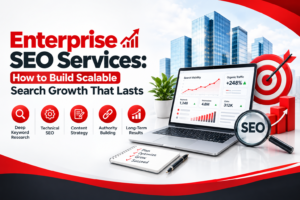
Enterprise SEO Services: How to Build Scalable Search Growth That Lasts
Your business has expanded. Your website has expanded alongside it. More products, more services, more locations, more content, and more customers now rely on your digital presence. However, growth can bring about a problem you might not spot right away: your website becomes more difficult to manage, more difficult to optimize, and more difficult for search engines to comprehend. Also, a handful of underperforming pages might not appear serious. Yet once your website holds hundreds or thousands of URLs, minor SEO issues can escalate rapidly. Duplicate content, weak internal linking, slow pages, inconsistent messaging, keyword overlap, and indexing problems can silently restrict your organic growth. This is where enterprise SEO services prove their worth. Instead of handling SEO as a set of separate tasks, enterprise SEO unites your website structure, content, technology, user experience, and business objectives into a single scalable growth system. Enterprise SEO Services Help You Turn Website Complexity Into Opportunity When you run a large website, SEO is seldom as straightforward as picking a handful of keywords and publishing blog posts. You have to grasp how your whole website functions. Which pages ought to rank? Which pages are competing against one another? Are the important pages getting indexed? Can users move easily from informational content to product or service pages? Are location pages truly helpful? Does your technical infrastructure enable search visibility as your website grows? However, these questions lay the groundwork for successful enterprise SEO. A scalable SEO program goes beyond individual rankings. It takes into account your full search ecosystem and spots opportunities that can boost visibility across categories, locations, products, services, and customer journeys. The outcome is a better-organized website that is easier for both search engines and your customers to navigate. Enterprise SEO Strategy Starts With What Your Customers Actually Need It’s easy to fall into the trap of basing SEO solely on search volume. However, keywords with high search volume don’t necessarily turn into valuable customers. The way your customers search varies according to their stage in the buying journey. Moreover, a person who has just discovered a problem might look for informational content. Someone else might be weighing different solutions against each other. A customer who is ready to purchase may look for a particular product, service, provider, or location. Your enterprise SEO strategy ought to take all of these moments into consideration. Additionally, that involves producing content that responds to genuine questions, building landing pages centered on meaningful search intent, reinforcing internal links among related topics, and making the next step clear for visitors. Once SEO mirrors the customer journey, organic traffic stops being merely a numbers game. It turns into a chance to establish trust even before the sales conversation starts. Enterprise SEO Solutions Give You a Stronger Technical Foundation Picture expanding your website with hundreds of new pages, yet lacking any clear structure. As time passes, search engines might find it hard to locate the pages that are most important. Visitors could likewise struggle to locate the information they require. Technical SEO lays the groundwork that keeps a large website in good health. However, your strategy might need to cover areas like: Website architecture and URL structure Crawlability and indexation Internal linking XML sitemaps Canonicalization Page speed and Core Web Vitals Mobile usability Redirect management Duplicate or thin content Structured data where appropriate Hence, the aim is not to complicate your website. It is quite the reverse. It is to make your digital ecosystem simpler to understand, simpler to navigate, and simpler to scale. That is why effective enterprise SEO solutions blend technical expertise with practical business thinking. Your Content Should Scale Without Losing Its Human Voice Big websites often run into a different problem: generating sufficient content while avoiding repetition. Having more pages doesn’t necessarily translate into greater value. Your audience can recognize when a page exists only to target a keyword. Search engines are likewise built to highlight helpful, pertinent content instead of content made purely to game rankings. However, a smarter strategy involves creating content that addresses real customer needs. Consider the questions your sales team keeps hearing. Consider the objections that stop customers from converting. Consider the comparisons customers make before settling on a solution. Those insights can be turned into worthwhile content. Your content strategy can then grow to include buying guides, service pages, product information, FAQs, industry resources, location-specific content, comparison pages, and thought leadership all while keeping a consistent brand voice. Here is where enterprise SEO services can align content strategy with business goals. You Need SEO, UX, and Conversion Working Together Bringing visitors to your website is just one step in the overall process. When your site is confusing, sluggish, hard to navigate, or vague about the next step for visitors, extra traffic might not translate into real business growth. That is why your SEO efforts should complement user experience and conversion optimization. However, intuitive navigation helps visitors find the information that matters to them. Well-organized page structure makes content simpler to absorb. Effective calls to action can steer users toward enquiries, purchases, consultations, or other valuable outcomes. This combined approach matters especially for expanding businesses, since SEO, web development, UI/UX, analytics, and digital marketing ought not to function in isolated silos. SpotCodes merges technology-driven marketing with web development, ecommerce solutions, internet marketing, IT expertise, and UI/UX skills to drive wider digital growth. The company also points to its Google and HubSpot certifications as evidence of its digital expertise. Enterprise SEO Services Should Be Measured by Business Impact Rankings can serve as helpful indicators, but they don’t tell the whole story. However, you need to determine whether organic search is driving meaningful business results. Based on your goals, that might include: Qualified organic traffic Leads and enquiries Ecommerce revenue Conversion rates Non-branded search visibility Growth in priority categories Organic performance by location Engagement with key landing pages Customer acquisition opportunities Furthermore, consistent reporting helps you see what is working, what needs improvement, and where new opportunities lie. Even more